The Occiput and Atlas: Where Your Skull Meets Your Spine
The atlanto-occipital joint — where the base of your skull meets C1 — is one of the most neurologically significant joints in the body. It cannot be fully corrected without addressing both the cranium and the upper cervical spine together.

There is a place in your body where the skull becomes the spine — where bone meets bone at a joint so neurologically dense, so anatomically complex, and so functionally critical that I consider it the most important transition zone in the human body. It is the atlanto-occipital joint: the articulation between the occiput (the base of your skull) and C1, also called the atlas.
Every neurological signal between your brain and body passes through this region. The vagus nerve exits here. The vertebral arteries enter the skull here. The brainstem becomes the spinal cord here. Cerebrospinal fluid flows through here. The dural tube begins here.
And yet, this joint cannot be fully corrected from the cervical spine alone. To properly address the atlas, you must first understand and address the occiput — which means understanding cranial adjusting.
The Anatomy of the Atlanto-Occipital Joint
The atlas (C1) is unique among vertebrae. It has no body — it is essentially a bony ring with two broad lateral masses that support the weight of the skull through two concave articular surfaces called the superior facets. The occiput has two convex protuberances called the occipital condyles that rock in those superior facets like a ball in a socket.
This joint allows the nodding motion of the head — yes-type movement — with approximately 15 degrees of flexion and 25 degrees of extension. It is not a joint designed for significant rotation; that happens at C1-C2 (the atlanto-axial joint).
But the atlanto-occipital joint's significance goes far beyond its range of motion. What passes through and around this region is what makes it extraordinary:
- The brainstem and spinal cord — the neural axis of the entire body transitions through the foramen magnum, the large opening in the occiput, at exactly this level
- The vagus nerve (CN X) — exits through the jugular foramen, formed by the junction of the occiput and temporal bone, just lateral to the atlanto-occipital joint
- The vertebral arteries — enter the skull through the foramen magnum after ascending through the transverse foramina of C1-C6, supplying the posterior brain, cerebellum, and brainstem
- Cerebrospinal fluid — flows between the cranial vault and the spinal canal through the foramen magnum, subject to any restriction in this transition zone
- The dural tube — the outer membrane of the spinal cord attaches firmly to the atlas and axis before continuing down to the sacrum
The Dural Tube: Occiput to Sacrum
The dura mater — the tough outer membrane surrounding the brain and spinal cord — attaches at specific cranial points (primarily the occiput, atlas, and axis) and then runs as a continuous tube all the way to the sacrum, where it attaches again at S2.
This means the occiput and the sacrum are in direct mechanical communication through the dural tube. Restriction in the occiput's motion translates directly into tension in the dural tube — and that tension is transmitted all the way to the sacrum. Conversely, sacral dysfunction creates dural tension that pulls on the cranium.
This is the anatomical basis for a fundamental SOT clinical observation: when a patient's sacrum is corrected, their occipital tension often improves. When the occiput is corrected, the sacrum often releases. They are one continuous mechanical system.
This also explains why isolated treatment of the upper cervical spine — without addressing the cranial component — often produces incomplete or temporary results. If the occiput is in a restricted position, it continuously re-stresses the atlas regardless of how precisely the C1 is adjusted.
You Cannot Fully Correct C1 Without Correcting the Occiput First
This is one of the most important clinical principles I operate from, and it is one that many patients have experienced without knowing the reason: they get their "upper neck" adjusted repeatedly, feel temporary relief, but the problem keeps coming back. The reason is often that the occiput — which sits above C1 and drives its position mechanically — has not been addressed.
The atlas sits in the space between the occiput above and the axis (C2) below. Its position at any given moment is the result of forces coming from both directions. The occipital condyles, resting in the superior facets of C1, dictate significant constraint on atlas position. If the occiput is locked in a lateral tilt, the atlas is pulled into a compensatory position beneath it. Correcting the atlas without first normalizing the occiput is like straightening a picture frame while the wall behind it remains crooked.
The SOT approach sequences the correction: evaluate the occiput first, correct cranial restriction, then assess C1. Often C1 self-corrects once the occiput is released. When adjustment of C1 is still needed, it holds far better and longer when the occipital foundation has been properly set.
Symptoms of Atlanto-Occipital Joint Restriction
The symptom picture of AO joint dysfunction is often described as affecting "the whole head" — because the brainstem, CSF flow, and vagal output are all involved. Common presentations include:
Suboccipital and Base-of-Skull Headaches
The dense suboccipital musculature — the group of small muscles connecting the occiput to C1 and C2 — becomes chronically hypertonic when the AO joint is restricted. These muscles are packed with proprioceptive nerve endings; chronic tension here creates a constant nociceptive barrage that manifests as that characteristic "vice grip at the base of the skull" headache.
Cervicogenic Dizziness
The upper cervical spine, particularly C1-C2, has an extraordinarily dense concentration of mechanoreceptors that contribute to spatial orientation and balance. When the AO joint is restricted, the proprioceptive information from this region becomes distorted, contributing to dizziness, imbalance, and visual wobbling — particularly with head movement.
Swallowing Difficulty
The glossopharyngeal nerve (CN IX) and the vagus nerve (CN X) both exit near the AO joint through the jugular foramen. Chronic restriction here can produce subtle swallowing difficulty, throat tightness, or the sensation of a lump in the throat (globus sensation).
Upper Cervical Pain Radiating to the Occiput
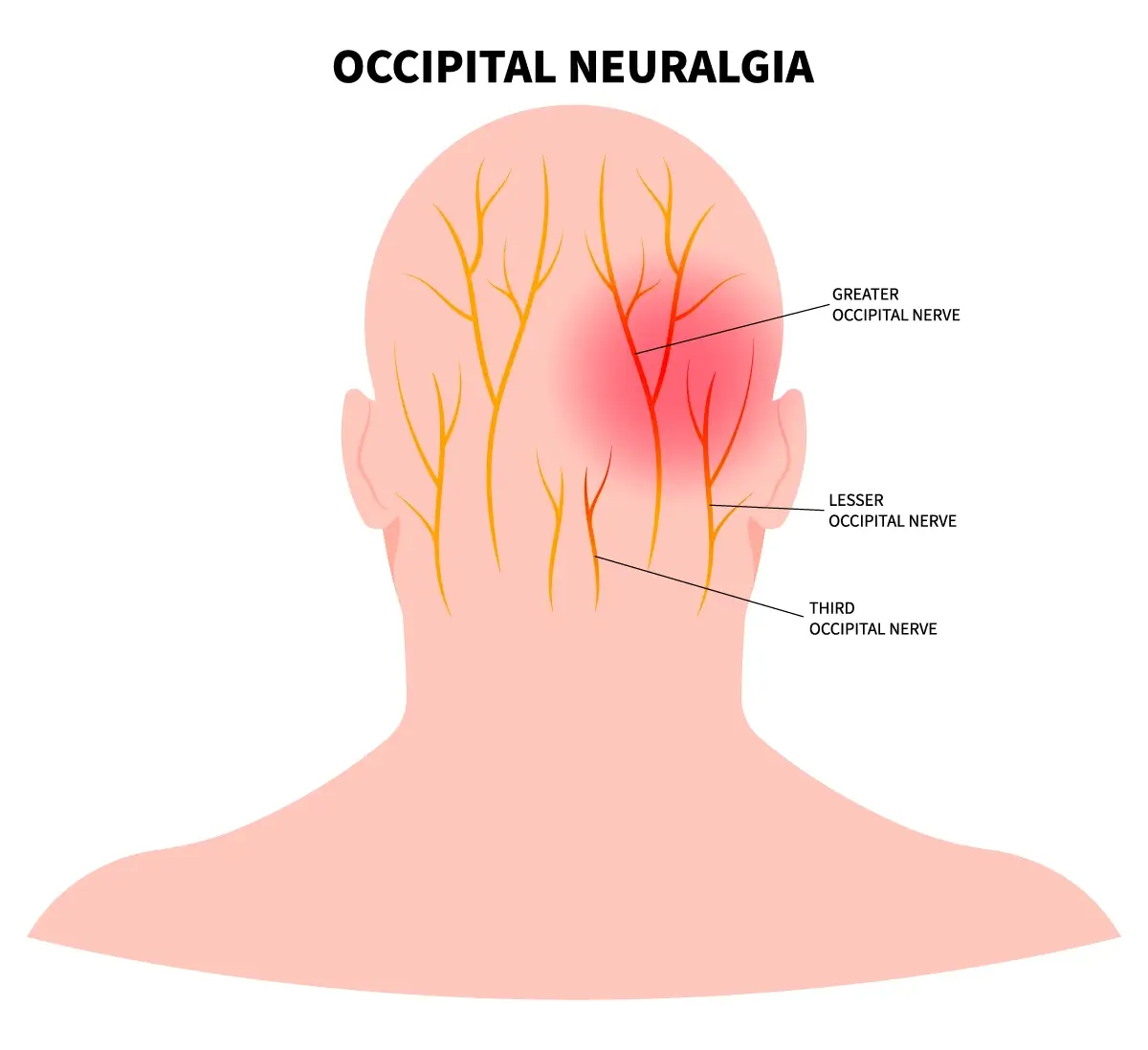
Pain that starts at C1-C2 and radiates up into the occiput, sometimes continuing over the top of the skull to the eyes, is a classic AO joint presentation. The greater occipital nerve — a branch of C2 — is frequently entrapped by hypertonic suboccipital muscles in AO joint dysfunction.
Whiplash and Post-Concussion Syndrome
In my clinical experience, the atlanto-occipital joint is always involved in whiplash injuries — always. The extreme range of motion produced in a rear-end collision takes the AO joint well beyond its normal constraints, producing ligamentous strain, dural tension, and often an occipital shift relative to C1 that does not self-correct.
Post-concussion syndrome — the persistent constellation of headaches, cognitive fog, light sensitivity, balance disturbances, and mood changes that follow head injuries — has a significant cranial-cervical component. The AO joint and the occiput are almost invariably restricted in these patients. Addressing the cranial mechanism — not just the cervical spine, not just pharmacological management — is an essential part of post-concussion recovery for many patients.
I see post-concussion patients fairly regularly in practice, often referred by patients who've seen results for similar issues. This is careful, progressive work — we are working in a neurologically sensitive zone — but it is often the care that finally moves the needle when other approaches have stalled.
The Vagus Nerve at the Jugular Foramen
As I've discussed in other posts, the vagus nerve exits the skull through the jugular foramen — a canal formed by the occiput and the temporal bone, just lateral to the atlanto-occipital joint. Restriction of the occiput — particularly in lateral flexion strains — narrows the jugular foramen and compresses vagal output.
The clinical consequences of impaired vagal tone are widespread: reduced digestive motility, elevated resting heart rate, impaired immune regulation, heightened anxiety, and disrupted sleep. Correcting the occiput and restoring normal jugular foramen dimensions is one of the primary mechanisms by which cranial adjusting improves systemic vagal function.
Key Takeaways
- The atlanto-occipital joint is the most neurologically significant transition zone in the body — it is traversed by the brainstem, vagus nerve, vertebral arteries, CSF, and the dural tube.
- The dural tube connects the occiput to the sacrum in a continuous mechanical chain. Cranial and sacral function are directly interdependent.
- C1 cannot be fully corrected without first addressing the occiput — the occipital condyles constrain atlas position, and the atlas will re-subluxate under an unreleased occiput.
- Symptoms of AO restriction include suboccipital headaches, cervicogenic dizziness, swallowing difficulty, and upper cervical pain radiating into the skull.
- Whiplash and post-concussion syndrome virtually always involve the atlanto-occipital joint and require cranial as well as cervical care for full resolution.
- Occipital correction restores jugular foramen dimensions and improves vagal nerve output — with downstream benefits for digestion, immune function, and autonomic balance.
If you've been dealing with persistent upper neck pain, base-of-skull headaches, post-concussion symptoms, or dizziness that nobody has been able to fully explain, a comprehensive atlanto-occipital and cranial evaluation may be exactly what you need. Call Pura Vida Chiropractic at (210) 685-1994. We're at 2318 NW Military Hwy #103, San Antonio, TX. Hablamos español.